|
||
 |
||
|
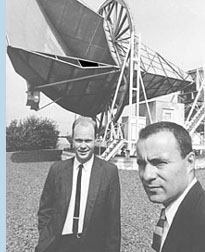
In 1964, Arno Penzias and Robert Wilson (pictured) were radio astronomers working at Bell Laboratory. They were attempting to distinguish and measure sources of noise in the atmosphere using a well-calibrated horn antenna. They found that a persistent signal occurred regardless of direction in which the antenna was pointing. Penzias and Wilson were lacking a satisfactory explanation for their observations and thought the signal was due to some undetermined systematic noise or equipment malfunction. It soon came to their attention through Robert Dicke and Jim Peebles of Princeton University that this background radiation had been predicted years earlier (1948) by George Gamow, Ralph Alpher, and Robert Herman as a relic of the evolution of the early universe. It was determined that the radiation was diffuse and emanating uniformly from all directions in the sky, and had a temperature of approximately 3 Kelvin (2.73K). They had discovered evidence of the Big Bang - the CMB. Penzias and Wilson received the Nobel Prize for their discovery in 1978. More history in abbreviated form is in this CMB time line. ___________________________________________________________________________________
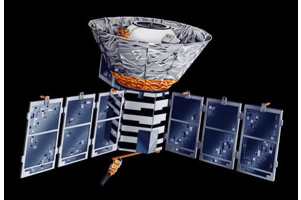
NASA's COBE (Cosmic Background Explorer) satellite was developed to measure the diffuse infrared and cosmic microwave background radiation from the early universe to the limits set by our astrophysical environment. COBE was launched on November 18, 1989 and carried three instruments: The DMR (Differential Microwave Radiometers) to precisely map the cosmic microwave background radiation. George Smoot was Principle Investigator on the DMR and was co-awarded the 2006 Nobel Prize for his contribution to this project. The DIRBE (Diffuse InfraRed Experiment) was developed to search for and measure the cosmic infrared background radiation, and FIRAS (Far-InfraRed Absolute Spectrophotometer) compared the spectrum of the cosmic microwave background radiation with that from a precise blackbody. Read about COBE here. ___________________________________________________________________________________
Cause and Effect The universe was once very hot and dense, and the photons and baryons formed a plasma. As the universe expanded and cooled, the radiation (photons) decoupled from the matter. The radiation cooled and is now at 2.73 Kelvin. The fact that the spectrum of the radiation is almost exactly that of a black body implies that it could not have had its origin through any prosaic means. This led to the demise of the steady state theory.
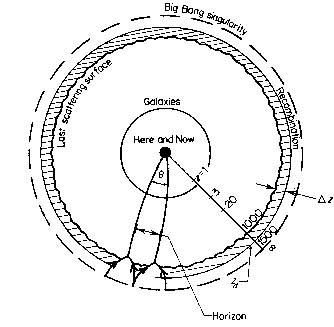
The temperature of the cosmic background radiation changes down by the same factor (1 + z). At early epochs (for z>1000), this temperature was high enough that most of the universe was ionized, and therefore opaque (optically thick). The surface z=1000 is sometimes called the cosmic photosphere, in comparison with the photosphere (apparent surface) of the Sun. It is the surface from which the cosmic background photons last scattered before coming to us. This “wall of light“ is called the surface of last scattering since it was the last time most of the CMB photons directly scattered off of matter. When we make maps of the temperature of the CMB, we are mapping this surface of last scattering. The light coming from this cosmic photosphere can be used to make an image of the early universe. One can then learn about the universe when it was a 1000 times smaller than the present. In 1967, Sachs and Wolfe determined that any observed temperature disparities were directly related to changes in the density variations. Having very little data, cosmologists referred to the Cosmological Principle. This states that on the average the universe looks the same from any point. It is motivated by the Copernican argument that the Earth is not in a central, preferred position. If the universe is locally isotropic, as viewed from any point, it is also uniform. So the cosmological principle states that the universe is approximately isotropic and homogeneous, as viewed by any observer at local rest. (See U2 Anisotropy Experiment archives for the effect of observer motion). The CMB should then appear to be approximately isotropic. Further investigations, including those by the COBE satellite (Smoot, et al) confirmed the virtual isotropy of the CMB to better than one part in ten thousand.
Given this qualification (checked in limited regions by small angular scale observations) any attempt to interpret the origin of the CMB as due to present astrophysical phenomena (stars, radio galaxies, etc.) is discredited. Therefore, the only satisfactory explanation for the existence of the CMB lies in the physics of the early universe. While the CMB is predicted to be very smooth, the lack of features cannot be perfect. At some level one expects to see irregularities, or anisotropies, in the temperature of the radiation. These temperature fluctuations are the imprints of processes and features of the early universe. The COBE DMR instrument first detected these imprints and made them public in 1992. Usually the features of the Universe and the CMB are interpreted in the context of a cosmological model - The Big Bang - that is derived from general cosmological principles and observations. Some of the features of the Big Bang model are discussed in the Science Goals subsection on the Origin of Large Scale Structure. ___________________________________________________________________________________
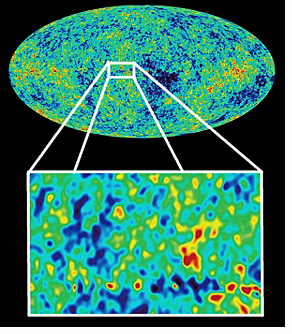
What do the different colors on the map of the CMB represent?
Although the temperature of the CMB is almost completely uniform at 2.7 K, there are very tiny variations, or anisotropies, in the temperature on the order of 10-5 K. The anisotropies appear on the map as cooler blue and warmer red patches. These anisotropies, or "ripples" in the temperature map, correspond to areas of various density fluctuation in the early Universe. Eventually, gravity would draw these fluctuations into even denser ones. After billions of years, these minute ripples in the early universe evolved, through gravitational attraction, into the planets, stars, galaxies, and clusters of galaxies that we see today.
___________________________________________________________________________________
Planck is an ESA (European Space Agency) mission. The Planck Surveyor mission will help provide answers to some of the most important questions asked in modern science - how did the universe begin, how did it evolve to the state we observe today, and how will it continue to evolve in the future? Planck's objective is to analyze, with the highest accuracy ever achieved, the remnants of the radiation that filled the universe immediately after the Big Bang, which we observe today as the CMB.
___________________________________________________________________________________
|